
If you’ve ever clicked on a piece of blue, underlined text on a webpage, you’ve used anchor text. It’s such a small, everyday part of browsing the internet that most people never think twice about it — but for SEO professionals, it’s one of the most important (and most misused) ranking signals on the web.
In this guide, we’ll break down what it is, why it matters for both search engines and users, the different types you should know, and the best practices that separate natural, effective linking from spammy, penalty-inviting linking.
What Is Anchor Text?
Anchor text (sometimes called “link text”) is the clickable, visible words of a hyperlink. It’s the phrase a reader clicks on to be taken to another page — whether that’s another page on the same website, an external site, a downloadable file, or even a specific section further down the same page.
In HTML, this wording sits inside an <a> tag, like this:
<a href="https://backlinksforge.com/services">link building services</a>
Here, “link building services” is the clickable phrase, and the URL in the href attribute is the destination the link points to. Browsers typically style these words differently from the surrounding content — underlined, in a different color, or both — so readers instantly recognize them as something clickable.
A good link label does two jobs at once: it tells a human reader what they’ll find if they click, and it tells a search engine crawler what the destination page is about. That second job is where it starts to matter a lot for SEO.
Why It Matters for SEO
Search engines use this clickable phrasing as a contextual clue about the content of the page being linked to. When many pages across the web link to a page using similar wording, it reinforces to Google what that page is actually about — almost like a vote of relevance, not just popularity.
This works differently depending on the link type:
- Internal links (links from one page to another on the same site) rely on descriptive link labels to help both users and search engines understand site structure and how pages relate to one another. Clear internal linking makes it easier for visitors to navigate and for crawlers to discover and categorize your content.
- External links (links pointing to a different domain) pass some authority and context to the destination site. This is part of why backlinks — and the words used to link them — are central to link-building strategy. A backlink with a relevant, descriptive label is generally more valuable than one with a vague “click here.”
Because this small detail plays into how search engines interpret relevance, it’s also a common target for manipulation — which is exactly why Google keeps a close eye on unnatural link patterns. More on that in the best-practices section below.
Types of Anchor Text
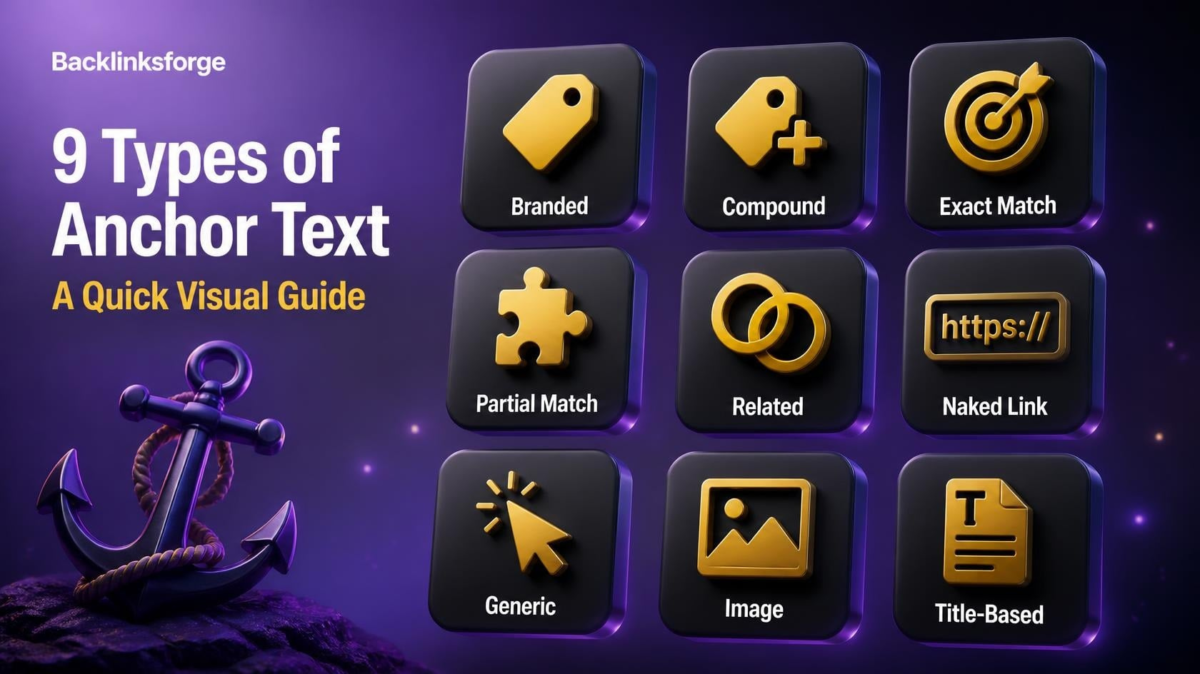
Not every link label looks or functions the same way. Here are the main categories worth knowing:
1. Branded Uses a company or brand name on its own — for example, linking the words “Backlinksforge” to your homepage. It’s a safe, natural-looking option often used when citing a source.
2. Compound Combines a brand name with extra descriptive words, such as “Backlinksforge’s guest posting guide.” This adds context while still keeping the brand front and center.
3. Exact-Match The clickable phrase mirrors the exact keyword the destination page targets — for instance, linking “guest post outreach” directly to a page optimized for that term. This can help the linked page rank for that keyword, but overusing this pattern across many links is one of the fastest ways to trigger a spam flag.
4. Partial-Match Includes a variation of the target keyword along with additional words, like “learn about guest post outreach strategies.” It gives context without being a rigid keyword match.
5. Related/Synonym Uses a related term or synonym instead of the exact keyword — for example, linking “off-page SEO tactics” to a page primarily targeting “link building.” This adds topical variety and looks more natural to search engines.
6. Naked Link The clickable text is simply the raw URL itself, such as www.backlinksforge.com. This is common in citations, footnotes, or reference lists, but it offers little descriptive value for SEO.
7. Generic Non-descriptive phrases like “click here,” “read more,” or “this page.” These tell the reader almost nothing about the destination and carry very little SEO weight, though they’re sometimes fine in small doses when the surrounding sentence already makes the context clear.
8. Image-Based When an image is used as the link itself, its alt text effectively takes on this role. Writing clear, descriptive alt text matters just as much here as writing a good label for regular links.
9. Title-Based The clickable words match the exact title of the article or page being linked to. It’s straightforward and leaves no ambiguity about what the reader will find.
Best Practices for Optimizing Your Link Labels
1. Keep It Natural
Your link wording should read like a normal part of the sentence, not something forced in for SEO’s sake. Avoid stuffing multiple exact-match, keyword-heavy links into a short span of copy — that pattern is a textbook sign of manipulative linking to Google’s algorithms. Only link when it genuinely adds value for the reader, and vary the phrasing across links pointing to the same page rather than repeating the identical words every time.
2. Keep It Short
Aim for concise wording — ideally under five or six words. “Guest posting guide” works far better than “a complete guide to everything you need to know about guest posting.” Short, clear labels are easier to scan and immediately communicate where the link leads.
3. Make It Descriptive
Brevity shouldn’t come at the cost of clarity. The clickable phrase should give both readers and search engines a reasonably accurate idea of what’s on the other end of the link. If you’re unsure which wording best represents a page, look at the keywords that page already ranks for and borrow from that language.
4. Make Links Visually Obvious
Your link text needs to stand out from the surrounding copy — typically through underlining, a distinct color, or both. If readers can’t easily spot which words are clickable, they’ll miss the link entirely, which hurts both usability and the chances of that link getting clicked.
5. Watch Your Backlink Profile
While you control the wording on your own site, you can’t control how other sites link to you. Periodically auditing your backlink profile helps you spot patterns of excessive exact-match or compound phrasing pointing to your pages — a signal that could look manipulative to Google, even if you didn’t build those links yourself. In most cases, a handful of low-quality backlinks isn’t worth acting on, but a manual action penalty tied to unnatural links is a sign it’s time to disavow the offending ones.
Common Mistakes to Avoid
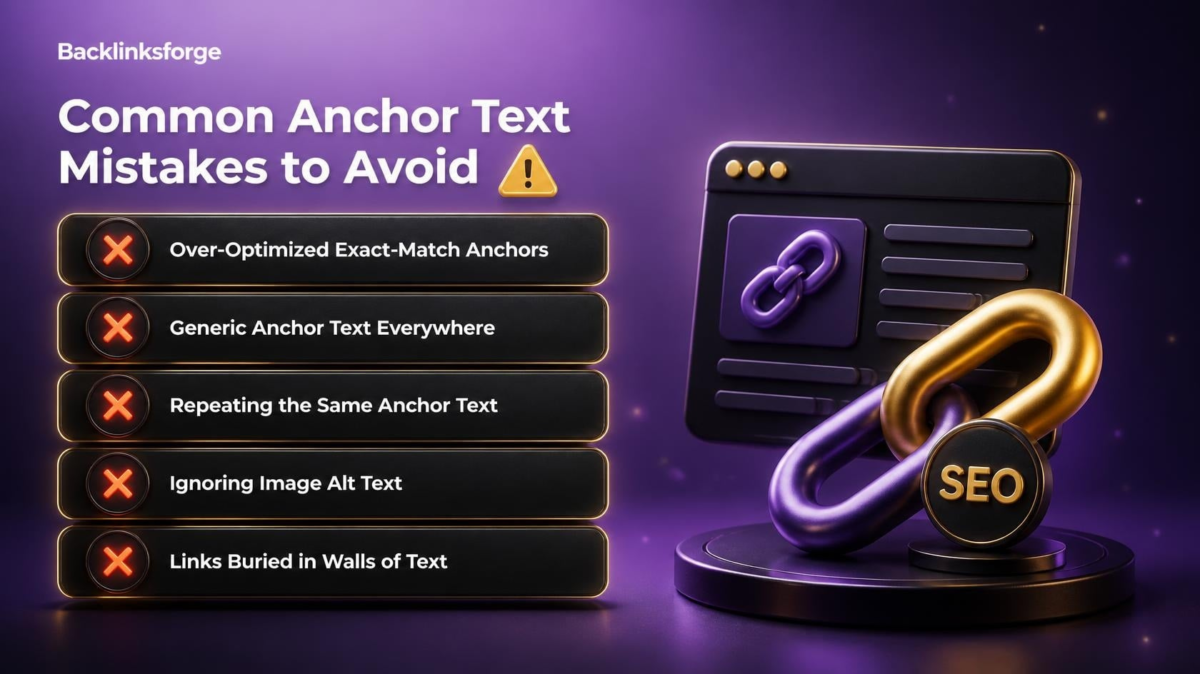
- Over-optimizing with exact-match keywords on nearly every link pointing to the same page
- Using generic, non-descriptive wording everywhere, which wastes an opportunity to add context
- Repeating the same link words to the same destination across a site or a set of backlinks
- Ignoring alt text on linked images, leaving that opportunity blank
- Burying links in walls of text with no visual distinction from regular copy
How We Handle This in Guest Post Campaigns
At Backlinksforge, link-label planning happens before a single outreach email goes out — not after a backlink is live. Here’s the approach we typically follow for clients:
- We map a healthy ratio for every campaign. A good mix usually looks like mostly branded and naked links, a moderate share of partial-match and related phrasing, and only a small percentage of exact-match wording. This ratio changes depending on the client’s existing backlink profile — a site that already has a lot of exact-match links gets fewer more, and a site with an under-optimized profile can absorb more.
- We check the linking page’s context first. A guest post about “content marketing tools” that awkwardly forces in an exact-match link for an unrelated service looks unnatural to both readers and Google. We match the wording to what the surrounding paragraph is actually about.
- We rotate variations across placements. If a client is getting five guest post links pointing to the same landing page, each one typically uses different wording — a branded mention, a partial match, a related term — instead of repeating the same exact phrase five times.
- We flag toxic or over-optimized patterns during audits. When we review a client’s existing backlink profile, spotting a spike in exact-match or compound phrasing pointing to one page is often the first sign of a previous over-aggressive link campaign — something we help correct going forward.
This kind of discipline is one of the reasons a guest posting strategy holds up over time instead of triggering a manual action months later.
Final Thoughts
This small detail on the page carries real weight for both user experience and search engine rankings. The goal is balance: descriptive enough to add context, short enough to stay readable, and varied enough to look — and be — completely natural. Whether you’re building internal links across your own site or earning backlinks through guest posts and outreach, getting your link wording right is one of the simplest ways to strengthen your overall SEO strategy.
If you’re working on a link-building campaign and want your link labels optimized without tipping into over-optimization, that’s exactly the kind of detail a good guest-posting strategy accounts for from the start.