
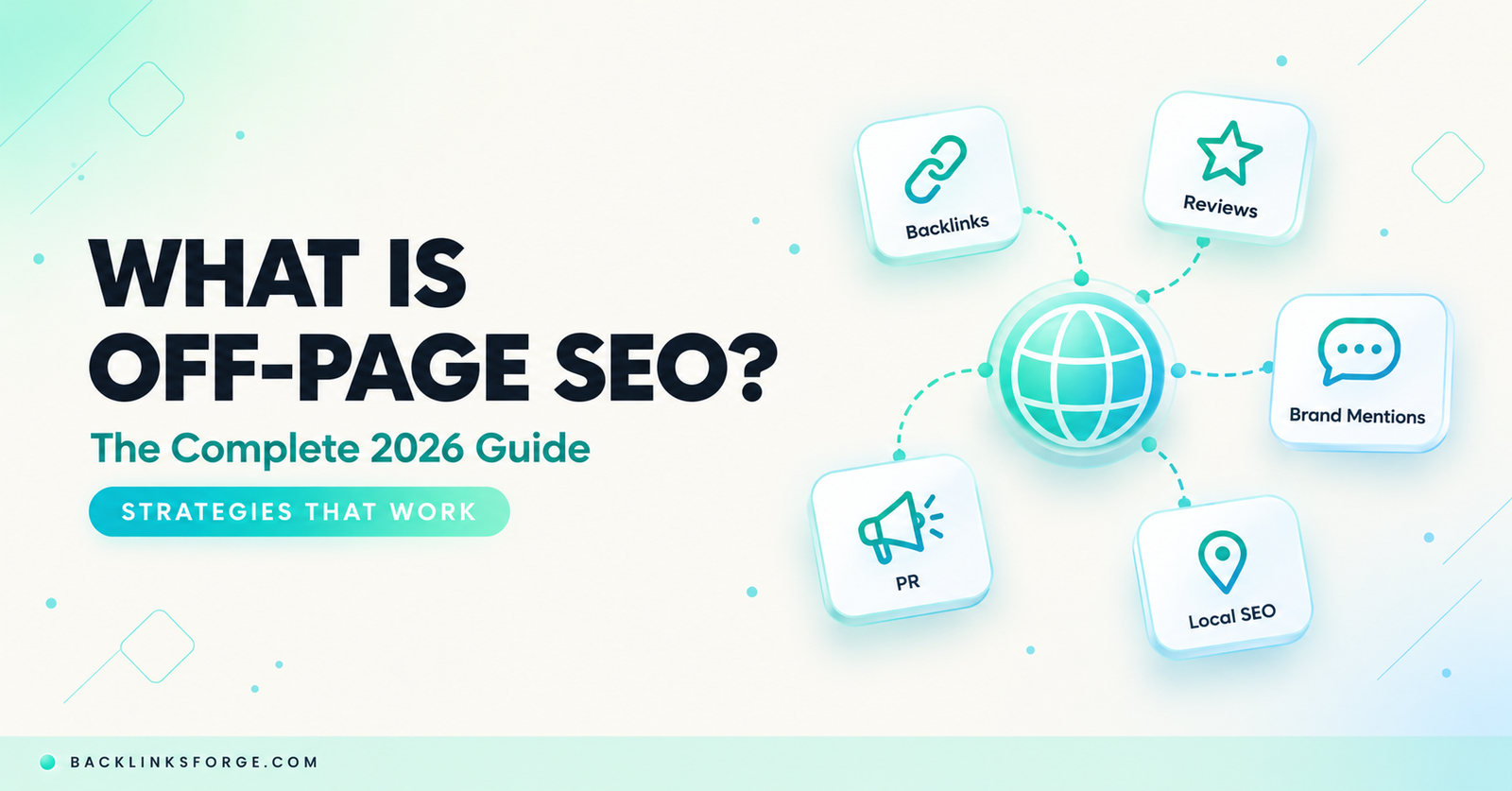
Off-page SEO is everything you do outside your website to build authority, trust, and rankings. Learn what it is, why it matters in 2026, and 12 proven off-page SEO techniques.
If you’ve ever fixed every technical issue on your site, written perfect meta tags, and optimized every heading — and your rankings still won’t budge — the missing piece is usually off-page SEO.
Search engines don’t just look at what’s on your website. They look at how the rest of the internet talks about you: who links to you, who mentions your brand, what people say in reviews, and whether real audiences engage with your content. That external reputation is what off-page SEO is built around, and in 2026 — with Google’s AI Overviews and AI search assistants pulling from the same trust signals — it matters more than ever.
This guide breaks down what off-page SEO actually is, why it influences rankings, and the exact techniques that move the needle today.
What Is Off-Page SEO?
Off-page SEO (also called off-site SEO) is the practice of improving your website’s search rankings through actions taken away from your own site — earning backlinks, generating brand mentions, building social proof, managing reviews, and getting other credible sources to vouch for you.
Where on-page SEO controls what you say about yourself, off-page SEO is about what everyone else says about you. Search engines treat the second kind of signal as far harder to fake — which is exactly why it carries so much ranking weight.
At its core, off-page SEO exists to answer one question for Google: can this website be trusted?
Why Off-Page SEO Matters in 2026
Google’s ranking systems are built around E-E-A-T — Experience, Expertise, Authoritativeness, and Trustworthiness. Three of those four pillars (Expertise, Authoritativeness, Trust) are proven almost entirely through off-page signals: who links to you, who cites you, and how your brand shows up across the web.
Here’s why off-page SEO has become non-negotiable:
- Backlinks remain one of the strongest ranking correlations across every major SEO study, year after year.
- AI Overviews and AI chatbots pull sources based on authority, not keyword density — the same brand-mention and citation signals that power classic SEO now decide whether you get cited by AI search too.
- Local rankings live or die on reviews and citations, not on-page content.
- Anyone can copy your on-page SEO. They can’t easily copy a decade of earned backlinks, press coverage, and brand trust.
In short: on-page SEO gets you eligible to rank. Off-page SEO gets you chosen to rank.
On-Page SEO vs. Off-Page SEO vs. Technical SEO
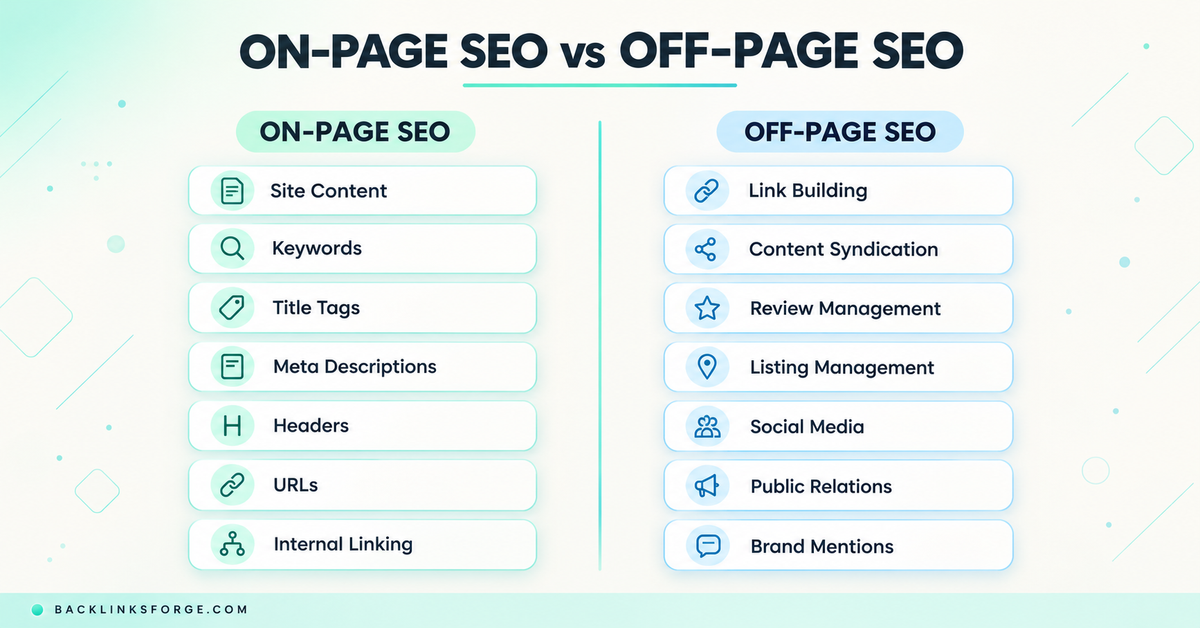
People often lump all of SEO together, but each pillar solves a different problem:
| Factor | On-Page SEO | Off-Page SEO | Technical SEO |
|---|---|---|---|
| Where it happens | On your own pages | Outside your website | Site infrastructure |
| Examples | Title tags, headers, internal links, content quality, keyword targeting | Backlinks, digital PR, brand mentions, reviews, social signals | Site speed, crawlability, indexing, mobile-friendliness, schema |
| What it proves to Google | Relevance to the query | Trust and authority | The site is technically accessible and healthy |
| Who controls it | You, fully | Partly you, partly others | You, fully |
You need all three working together. A technically flawless, perfectly optimized page with zero off-page authority will still lose to a decent page backed by strong external trust signals.
The Off-Page SEO Metrics That Actually Predict Rankings
Before jumping into tactics, it helps to know what you’re optimizing for. The strongest off-page ranking correlations, consistently shown across ranking-factor studies, include:
- Domain-level authority score — an aggregate trust score based on backlink quality/quantity and organic traffic
- Page-level authority score — the same concept applied to a single URL
- Referring domains — the number of unique websites linking to you (far more important than raw backlink count)
- Referring IP diversity — links coming from genuinely different servers/networks, not one PBN
- Total backlinks — still relevant, but only as a secondary signal once quality and diversity are accounted for
- Brand search volume — how often people search your brand name directly, a strong trust proxy
Tools like Ahrefs, Semrush, or Moz can show you most of these for your own site or a competitor’s — useful for benchmarking before you start a campaign.
12 Off-Page SEO Techniques That Work in 2026
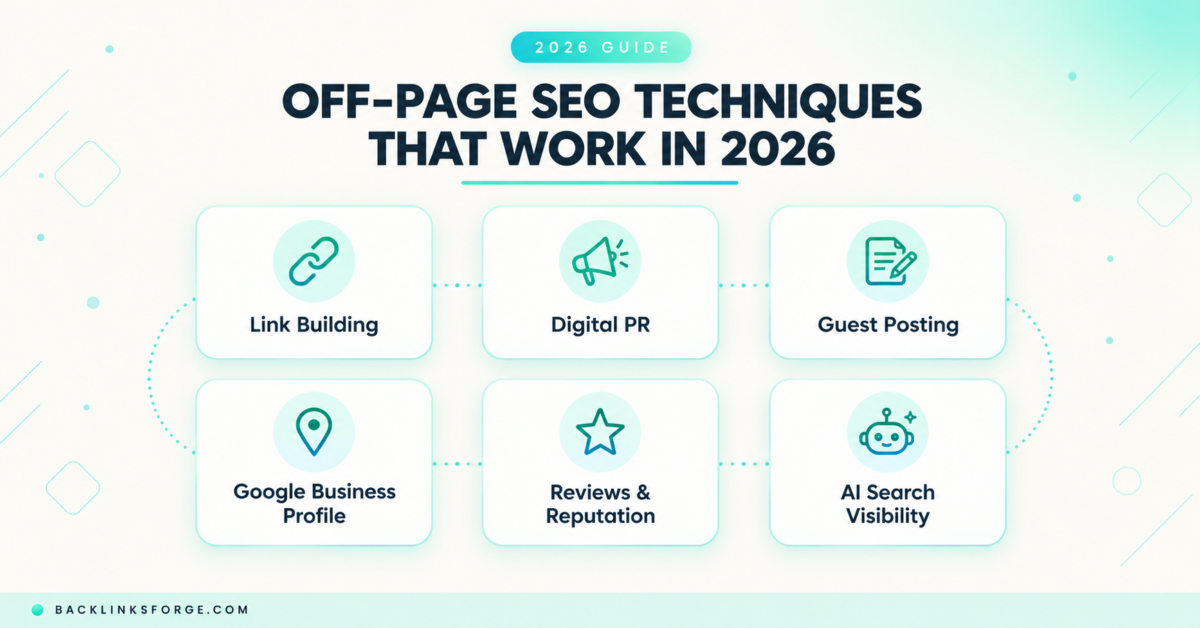
1. Strategic Link Building
Link building is still the backbone of off-page SEO — but the game has shifted from quantity to relevance and editorial quality. One contextual link from a respected, topically relevant site outweighs fifty low-quality directory links.
The highest-value link building methods right now:
- Guest posting on relevant, real-audience publications — not spam networks. The point isn’t just the backlink; it’s exposure to a new, relevant readership that trusts the publication.
- Broken link building — find dead pages on authoritative sites that used to link to a resource like yours, and pitch your (better) replacement.
- Skyscraper content — find a well-linked piece in your niche, build something noticeably more useful, current, or complete, then reach out to the sites linking to the original.
- Unlinked mention recovery — monitor the web for people already naming your brand without linking, and politely ask for the link to be added. This converts existing goodwill into equity almost for free.
- HARO-style journalist outreach — respond to reporters looking for expert quotes. A single mention in a major outlet can outperform months of cold outreach.
The rule that separates safe link building from risky link building hasn’t changed: if a link exists purely to manipulate rankings rather than to genuinely help a reader, it’s a liability, not an asset.
2. Digital PR
Digital PR merges traditional public relations with link building — pitching data, original research, or newsworthy angles to journalists and publications in exchange for coverage and links.
A well-executed campaign does more than build links. It:
- Increases branded search volume (a strong trust signal)
- Puts you in front of your actual target audience, not just search bots
- Produces links from domains with near-impossible-to-fake authority
- Compounds — one story often gets picked up and re-linked by smaller outlets for months afterward
The most linkable digital PR assets are usually original data, surveys, or expert commentary tied to a trending news angle — not generic company announcements.
3. Guest Posting Done Properly
Guest posting deserves its own callout because it’s the single most accessible off-page tactic for small and mid-sized businesses — and also the one most frequently done badly.
Done right, guest posting means:
- Targeting sites with real, engaged readerships in your niche — not “write for us” pages accepting anything for a fee
- Writing genuinely useful content the host site would want regardless of the link
- Earning a contextual, relevant link inside the body — not just an author-bio link
- Diversifying anchor text naturally instead of repeating exact-match keywords
Done wrong — mass outreach to link farms, spun content, irrelevant niches — it can actively hurt rankings. If you outsource this, work with people who vet publications for real traffic and topical relevance, not just a high “DA” number.
4. Content That Earns Links on Its Own
The most sustainable off-page strategy is publishing content people want to reference: original research, industry data, free tools, calculators, templates, or genuinely definitive guides. This is sometimes called “linkable asset” creation.
Instead of chasing every link manually, you create something so useful that other sites link to it unprompted — turning content marketing into a long-term, compounding off-page engine.
5. Social Media Signals
Social shares are not a direct Google ranking factor. But social media is still a critical off-page lever because it:
- Extends the reach of content that later earns real backlinks
- Drives branded searches, which are correlated with trust
- Builds an audience that journalists, bloggers, and influencers discover and cite
- Feeds AI-driven discovery, since large language models are increasingly trained and grounded on social conversation data
Consistency beats virality here. A steady drumbeat of repurposed content across LinkedIn, X, Instagram, and niche platforms compounds visibility over time.
6. Influencer and Creator Partnerships
Partnering with niche influencers and creators — not just mega-influencers — puts your brand in front of a pre-built, trusting audience. Micro-influencers with smaller but highly engaged niche followings often produce better off-page results than a single expensive celebrity post, because the mentions and links they generate are more topically relevant.
7. Forums and Community Engagement
Dropping links in Reddit or Quora threads does nothing for rankings and can get you banned. But genuinely answering questions, building a reputation, and being recognized as a go-to expert in niche communities (Reddit, Quora, industry-specific forums, Slack/Discord groups) drives real referral traffic, brand mentions, and — eventually — organic links from people who found you there.
8. Content Syndication (Done Carefully)
Republishing your content on platforms like Medium or LinkedIn Articles extends your reach to new audiences. The catch: Google will show whichever version it deems most relevant to a given search, which might not be your original. Always:
- Link the syndicated version back to your original post
- Use canonical tags where the platform supports them
- Wait a few days after original publication before syndicating, giving Google time to index your version first
9. Google Business Profile & Local Citations
For any business with a physical location or service area, an optimized Google Business Profile is arguably the single highest-leverage off-page asset available. It directly controls visibility in the map pack — often the highest-converting real estate on the entire results page.
Pair it with NAP consistency (Name, Address, Phone number matching exactly across every directory, citation site, and social profile). Inconsistent NAP data confuses both users and Google’s trust algorithms and is one of the most common local ranking killers.
10. Reviews and Reputation Management
Reviews function as crowdsourced trust signals. Google explicitly factors review quantity, recency, and sentiment into local rankings, and reviews influence click-through rate everywhere else too.
Best practices:
- Ask every satisfied customer for a review — don’t wait for it to happen organically
- Respond to every review, positive and negative, professionally
- Never buy or incentivize fake reviews — the downside risk (platform penalties, loss of trust) far outweighs any short-term gain
11. Events, Webinars, and Sponsorships
Hosting or sponsoring an event — virtual or in-person — generates a natural wave of mentions, social shares, and backlinks from attendees, partners, and press coverage, often from sites you’d never get through cold outreach alone.
12. Answer Engine & AI Visibility Signals
This is the newest off-page frontier. AI Overviews, ChatGPT, Perplexity, and similar tools decide what to cite largely based on the same authority signals search engines have always used — consistent brand mentions, quality backlinks, and third-party validation — plus how clearly your brand is described across the web (Wikipedia-style entities, structured citations, consistent naming). Building genuine off-page authority today is, increasingly, the same thing as building AI search visibility tomorrow.
Common Off-Page SEO Mistakes to Avoid
- Chasing link volume over relevance. Ten irrelevant links do less than one contextual link from a real site in your niche.
- Buying links from obvious PBNs or link farms. Google’s spam systems are very good at detecting unnatural link patterns, and the penalty risk isn’t worth it.
- Over-optimized anchor text. Repeating your exact-match keyword in every backlink looks manipulative and can trigger algorithmic scrutiny.
- Ignoring NAP consistency across directories, which quietly damages local rankings.
- Treating off-page SEO as a one-time project instead of an ongoing part of your marketing.
How to Build an Off-Page SEO Strategy (Step by Step)
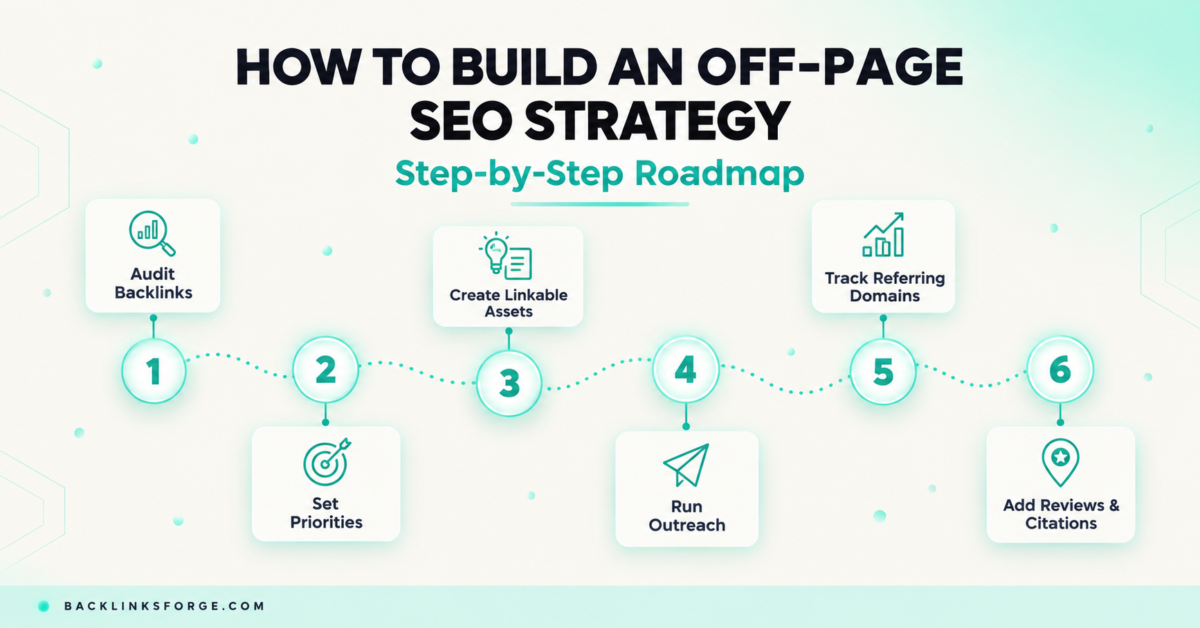
- Audit your current backlink profile and brand mentions to see where you stand and what competitors have that you don’t.
- Set clear priorities based on your business type — an e-commerce brand needs digital PR and content-driven links; a local business needs GBP optimization and reviews first.
- Create at least one linkable asset (original data, tool, or definitive guide) as the foundation of your outreach.
- Run consistent outreach — guest posting, journalist requests, unlinked mention recovery — on a monthly cadence, not a one-off sprint.
- Track referring domains, not just backlink count, and monitor branded search volume as a leading trust indicator.
- Layer in reviews, social consistency, and local citations if any part of your business is location-based.
Off-page SEO compounds. A single month of guest posts or PR rarely moves rankings on its own — but twelve consistent months of relevant links, mentions, and reviews build an authority profile that’s genuinely difficult for competitors to replicate.
Frequently Asked Questions
Is off-page SEO more important than on-page SEO? Neither works well alone. On-page SEO makes a page eligible to rank for a query; off-page SEO builds the trust and authority that decides whether it actually outranks competitors targeting the same query.
How long does off-page SEO take to show results? Most sites see meaningful movement after 3–6 months of consistent link building and brand-building activity, though competitive niches can take longer.
What’s the single highest-impact off-page tactic? For most businesses, earning contextual backlinks from relevant, real-audience publications — through guest posting, digital PR, or linkable content — delivers the strongest and most durable results.
Do social media shares directly affect rankings? Not directly, but they extend content reach, drive branded searches, and generate the visibility that leads to real backlinks — making social media an important indirect off-page factor.
Final Thoughts
Off-page SEO isn’t a checklist you finish once — it’s the ongoing process of earning the internet’s trust one link, mention, and review at a time. Focus on relevance over volume, build genuine relationships instead of chasing shortcuts, and treat every off-page tactic as a way to put your brand in front of real people, not just search engine crawlers. Do that consistently, and the rankings follow.