
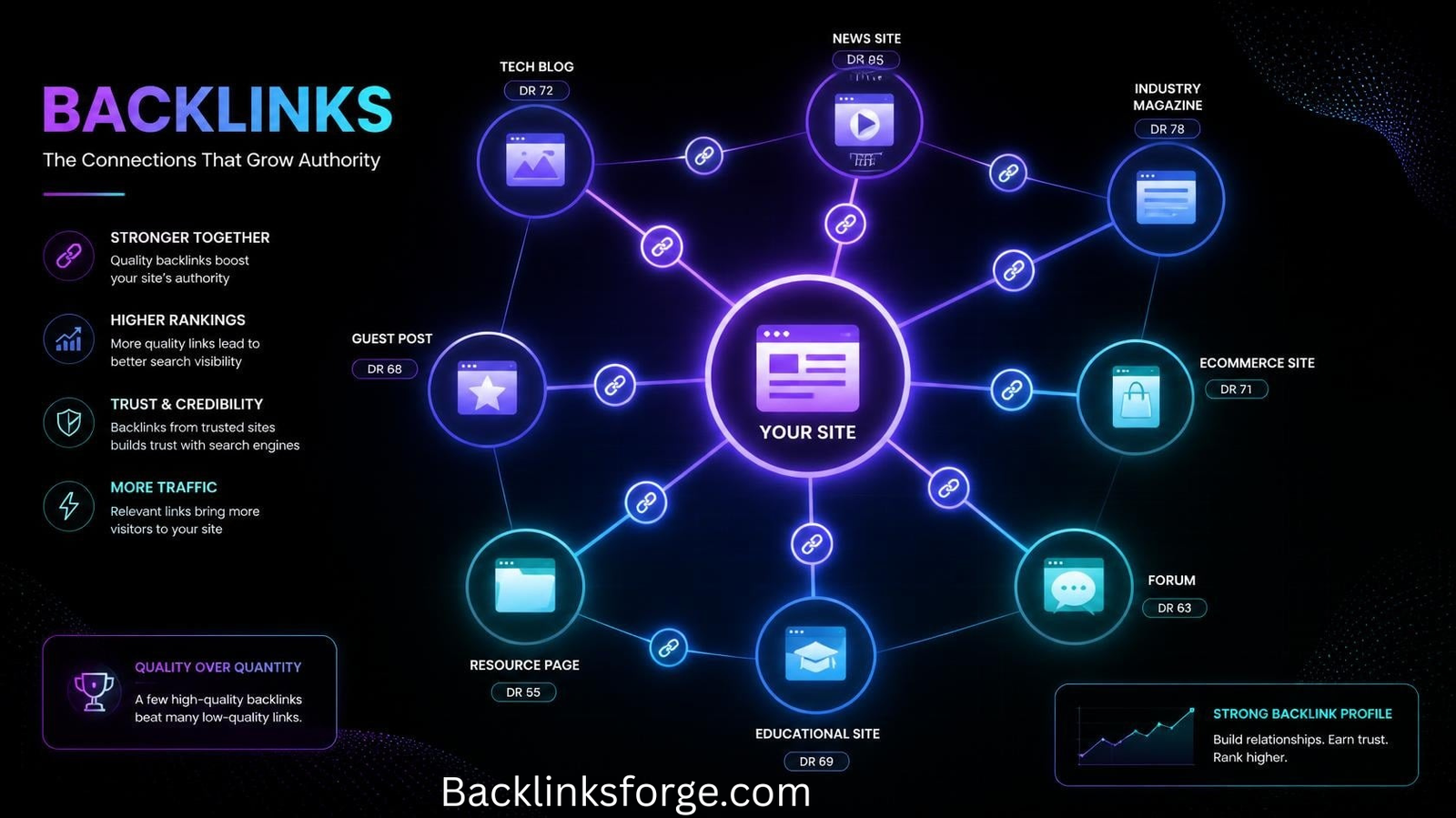
A new website has no history, no domain authority, and — in most cases — no backlinks. That combination makes link building the single most misunderstood part of early-stage SEO. Founders either ignore it entirely and wonder why a well-written site never ranks, or they rush into it and end up with a spam-flagged link profile before the site has even indexed properly.
Link building for a brand-new domain isn’t the same game as link building for an established one. The priorities are different, the risks are different, and the tactics that work for a 5-year-old site can actively hurt a site that launched last month. Search engines evaluate backlink profiles as part of a wider trust and authority signal — alongside domain age, content quality, and E-E-A-T (Experience, Expertise, Authoritativeness, Trustworthiness) — so a new domain has to earn that trust gradually rather than force it. This guide breaks down what actually matters in the first few months, in the order it matters, and how to build a link profile that survives future Google algorithm updates instead of getting flagged by one.
Why Link Building Works Differently For New Websites
Search engines don’t just look at how many links point to a page — they look at how a site’s link profile grows over time. A domain that goes from zero to 500 backlinks in three weeks doesn’t look like a business that’s earning attention. It looks like a manipulation pattern, and it gets treated that way.
A new website also has almost no “trust reservoir” to draw on. An established domain can absorb a few low-quality links without consequence, because its overall profile is strong enough to dilute the damage. A new domain doesn’t have that buffer. Every early link carries more relative weight — for better or worse.
That’s the core principle to hold onto through everything below: in the early stage, link quality, relevance, and pacing matter more than volume. A slow, natural-looking growth curve in referring domains is far safer than a spike that trips Google’s spam-detection systems (the modern successor to what used to be handled by manual actions and the Penguin update).
Step 1: Fix What Link Building Can’t Fix
Before acquiring a single backlink, the site itself needs to be link-worthy. This step gets skipped constantly, and it’s the reason so many early link-building campaigns underperform.
Check three things first:
- Indexation and crawl budget. If Google hasn’t properly crawled and indexed your key pages, links pointing to them won’t do much. Confirm indexing status in Search Console, check your XML sitemap, and fix any crawl errors before investing in outreach.
- On-page basics. Title tags, header structure, internal linking, canonical tags, and page speed all affect how much link equity an incoming link actually passes through. A backlink to a thin, unoptimized page is a wasted backlink.
- Keyword research and search intent alignment. Pages should already be built around the terms your target audience searches for, with supporting semantic and LSI (latent semantic indexing) keywords woven in naturally — this gives search engines topical context and makes the page worth linking to in the first place.
- Content worth linking to. This is the part most new sites underestimate. Nobody links to a generic service page. People and publications link to something specific — original data, a genuinely useful tool, a strong opinion piece, a resource that solves a real problem. If nothing on the site meets that bar yet, that’s the first project, not link building.
Step 2: Start With Linkable Foundations, Not Outreach
The instinct for a new site is to jump straight into cold outreach or guest posting. A better first move is building two or three “linkable assets” — pages specifically designed to attract links on their own merit.
Common formats that work well for new sites:
- An original study or survey with data nobody else has published
- A genuinely useful free tool or calculator relevant to your industry
- A deeply researched guide that’s meaningfully better than what currently ranks
- A well-designed comparison or “state of the industry” resource
These assets do two things simultaneously: they give you something worth pitching to journalists and bloggers, and they start earning a small number of natural links without any outreach at all. That early organic trickle is exactly the kind of signal search engines want to see from a young domain.
Step 3: Build A Foundational Link Layer
Before chasing editorial coverage, most new sites benefit from a base layer of low-risk, high-trust links. These won’t move rankings dramatically on their own, but they establish that the business is real and give crawlers reliable paths into the site.
This layer typically includes:
- Business directories and industry associations relevant to your niche — not mass directory submissions, just the handful that are actually credible in your space.
- Social profiles and profile links on platforms relevant to your industry.
- A few relevant citations if the business has a local or service-area component.
- Owned properties — a company blog, a Medium or LinkedIn article, a press release on a legitimate wire — that reference and link back to the main site.
None of this is glamorous, and none of it should be the whole strategy. But skipping it and going straight for competitive editorial links often means building on a foundation that looks incomplete to search engines.
Step 4: Earn Editorial Links Through Targeted Outreach
This is where most people think link building starts — and where it should actually begin only after Steps 1 through 3 are in place.
For a new site, outreach works best when it’s narrow and relationship-based rather than broad and templated.
Guest posting, done correctly, still works. The key distinction: the goal isn’t “get a link,” it’s “contribute something a specific publication’s audience actually wants to read.” Sites that approach guest posting as a numbers game — mass outreach, generic pitches, low-relevance placements — see diminishing returns and, increasingly, penalties. Sites that pick 10-15 genuinely relevant publications and pitch specific, well-thought-out angles see real authority transfer.
Niche edits (getting a link added to existing, already-ranking content) can be a faster way to gain authority than waiting for new content to rank, provided the placement is topically relevant and the surrounding content is high quality. Relevance matters more here than almost any other factor — a link from a tangentially related page does very little.
Digital PR — pitching journalists and industry writers using the data or research built in Step 2 — tends to produce the highest-authority links available to a new site, because publications with real editorial standards are exactly the ones search engines trust most.
Broken link building and resource page outreach are lower-effort tactics that still work reasonably well for new sites: find dead links or outdated resources on relevant pages, and offer your content as the replacement.
What to avoid entirely at this stage: PBNs (private blog networks), link farms, bulk directory blasts, comment-section and forum spam, paid links that violate Google’s link scheme guidelines, and any link package sold purely on quantity. These black-hat tactics don’t just risk a manual action or algorithmic penalty — for a domain with almost no established trust, they can suppress rankings before the site ever gets a fair chance to compete. Stick to white-hat, editorially earned links, and keep a healthy mix of dofollow and nofollow links, since an unnaturally “clean” all-dofollow profile is itself a pattern search engines flag.
Step 5: Pace The Growth Deliberately
New sites should aim for a link velocity that looks like organic growth, not a campaign. A rough framework:
- Months 1-2: Foundational links only (Step 3), plus publishing 1-2 linkable assets.
- Months 3-4: Begin targeted outreach at a modest pace — a handful of high-quality placements per month rather than dozens of low-quality ones.
- Months 5-6 onward: Scale outreach gradually as the site earns its first rankings and organic links start appearing on their own, which is the strongest signal that the strategy is working.
If a competitor with a 5-year-old domain is publishing 40 guest posts a month, that pace is not a benchmark for a new site to copy. It’s a pace that domain’s history can absorb — yours can’t yet.
Step 6: Track The Right Signals
Total backlink count is the least useful metric to watch in the early months. Track instead:
- Referring domains, not total links — ten links from ten different relevant sites are worth far more than fifty links from five sites.
- Topical relevance of linking pages — a link from a page discussing your actual subject matter outweighs a higher-authority link from an unrelated niche.
- Organic traffic to linked pages, not just the backlink itself — the point of a link is the ranking movement and traffic it eventually produces.
- Anchor text distribution — a natural profile is mostly branded and generic anchors (your brand name, “click here,” “this article,” naked URLs), with exact-match and partial-match keyword anchors used sparingly. An anchor profile that’s heavy on commercial keywords early on is a common trigger for scrutiny.
- Domain-level spam score and toxic link ratio — periodically audit your backlink profile (via Search Console or a third-party tool) and disavow genuinely toxic or spammy links before they drag down your overall trust signals.
The Realistic Timeline
Link building for a new website is not a fast channel, and most of the value compounds rather than appears immediately. A realistic expectation:
- First 60 days: little to no visible ranking movement, foundation being laid
- Months 3-5: early keyword movement, usually for lower-competition long-tail terms first
- Months 6-12: meaningful ranking gains for competitive terms, assuming consistent content and link acquisition throughout
Sites that try to compress this timeline by buying volume almost always end up worse off than sites that grew more slowly but more naturally. In link building, especially for a young domain, the fastest path and the safest path are rarely the same one — and betting on the fast one is usually a bet you lose.
Pairing this with an ongoing content marketing strategy — regularly publishing content optimized around your core keywords and their related semantic terms — keeps organic backlinks and organic traffic growing side by side, which is exactly the pattern that supports long-term SERP rankings instead of a short-lived spike.
The Bottom Line
Link building for a new website isn’t about acquiring backlinks as fast as possible — it’s about building a profile that looks like it belongs to a real, growing business, because that’s exactly what search engines are trying to identify. Get the on-page and content foundation right first, build a base layer of trust, then earn editorial links deliberately and at a sustainable pace. Sites that follow that order tend to build rankings that last. Sites that skip it tend to build rankings they eventually lose.