
Link building can feel like the fastest way to climb Google, which is exactly why so many beginners rush in and get it wrong. A few poor decisions, like buying cheap links or stuffing anchor text with keywords, can waste months of effort and even hurt your rankings. The good news is that most link building mistakes beginners make are easy to spot once you know what to look for. This guide walks through the ten most common ones, explains why they damage your SEO, and shows what to do instead.
Why Link Building Mistakes Hurt Your SEO So Much
Backlinks are still one of the strongest signals search engines use to decide whether a page deserves to rank. That works in both directions. A good link from a trusted, relevant site builds authority, but a bad one adds nothing at best and attracts a penalty at worst. Unlike a typo you can fix in seconds, a messy backlink profile can take months to clean up. Knowing the pitfalls upfront saves you time, money, and a lot of frustration.
Mistake 1: Chasing Backlink Quantity Instead of Quality
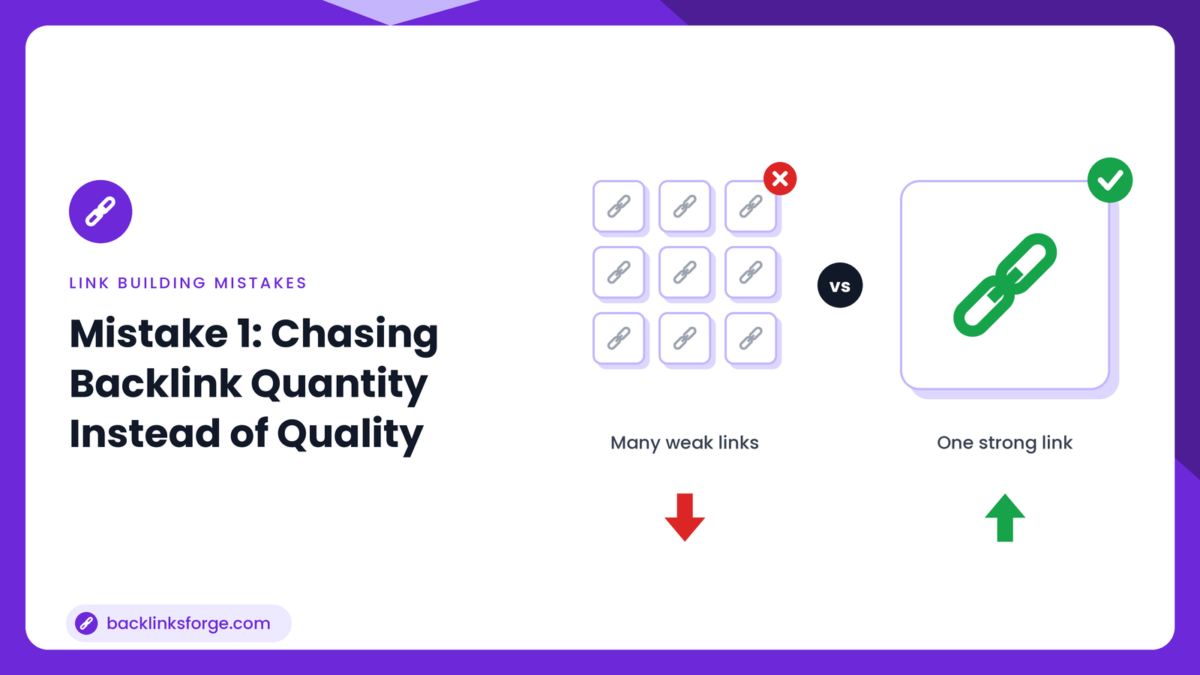
Why One Great Link Beats Fifty Weak Ones
Beginners often measure success by counting links. Search engines care more about where a link comes from than how many you have. A single editorial mention on a respected industry site can outperform dozens of links from directories, comment sections, or thin blogs nobody reads.
How to Judge a High-Quality Backlink
- Relevance: The linking site covers a topic related to yours.
- Real audience: The site has genuine traffic and readers, not just a high score in an SEO tool.
- Editorial placement: The link sits naturally inside useful content, not in a footer or sidebar.
- Trust: The site publishes original content and isn’t packed with paid or spammy links.
Third-party metrics like Domain Authority or Domain Rating are handy for quick comparisons, but they are estimates, not Google’s own scores. Use them as a filter, never as the only rule.
Mistake 2: Buying Links or Joining Link Schemes
What Google’s Spam Policies Say
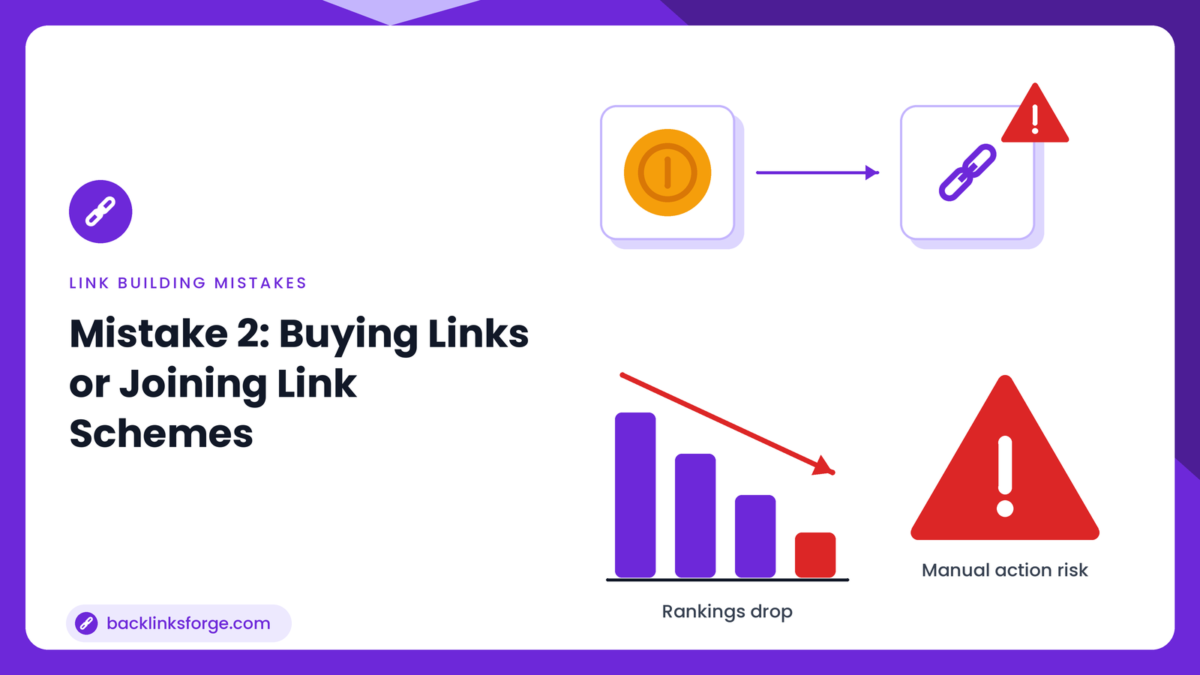
Paying for links that pass ranking value is one of the fastest ways to get into trouble. Google’s link spam policies specifically call out buying or selling links, excessive link exchanges, and automated link creation as violations.
Why Private Blog Networks and Cheap Link Packages Backfire
Private blog networks (PBNs), $10 link bundles, and “guaranteed high DA” offers usually rely on sites built only to sell links. Google can ignore those links entirely, and in serious cases it can apply a manual action that drops your rankings. If a link is paid, mark it with rel="sponsored". Otherwise, earn it.
Mistake 3: Ignoring Relevance and Topical Fit
A link from a cooking blog to your SEO agency makes little sense to readers or to search engines. Relevance tells Google your site belongs in a particular conversation. Before you pursue any link, ask whether the linking page’s audience would genuinely benefit from clicking through. If the answer is no, the link isn’t worth chasing, no matter how strong the site looks on paper.
How to Find Relevant Link Opportunities
Start with sites your customers already read: industry blogs, trade associations, niche newsletters, and podcasts in your field. Searching your main topic alongside phrases like “write for us” or “resources” can surface relevant pages quickly, and checking which sites already link to your competitors gives you a ready-made target list.
Mistake 4: Over-Optimizing Anchor Text
The Exact-Match Anchor Text Trap
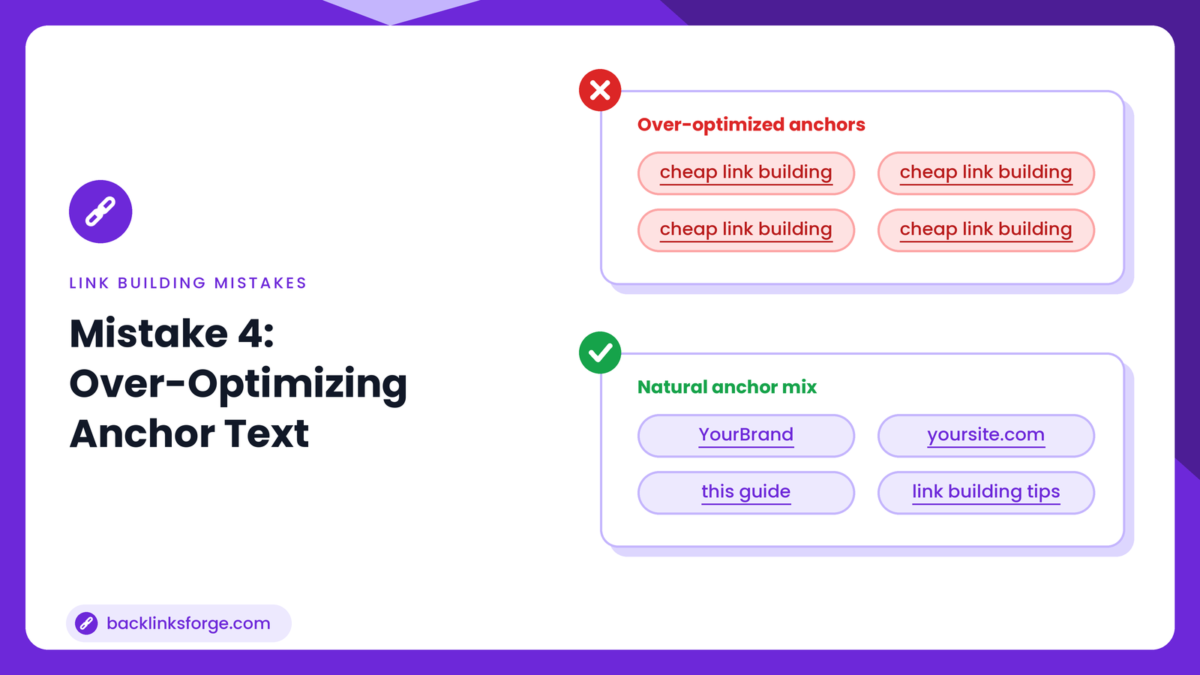
Anchor text is the clickable wording of a link. When beginners learn that keywords help, they ask every site to use the same exact-match phrase, such as “cheap link building services.” A backlink profile where most anchors are identical looks manufactured, and Google’s guidelines flag keyword-rich anchor text in large-scale guest posting campaigns.
What a Natural Anchor Text Profile Looks Like
- Branded: your business or website name
- Naked URL: your web address
- Generic: phrases like “this guide” or “read more”
- Partial match: a phrase that includes part of your keyword
- Exact match: used sparingly
Most of your links should be branded, URL, or generic. Let exact-match anchors be the exception rather than the rule.
Mistake 5: Skipping Internal Linking
Most beginners focus so hard on external backlinks that they forget the links they fully control. Internal links guide visitors to related pages, help crawlers discover and understand your content, and spread link equity from strong pages to newer ones. If a blog post earns a great backlink, linking from it to your service page passes some of that value along.
Simple Internal Linking Habits
- Link to related posts and key service pages from every new article.
- Use descriptive anchor text instead of “click here.”
- Fix orphan pages that have no internal links pointing to them.
Mistake 6: Sloppy Guest Posting and Outreach
Mass Emails That Get Ignored
Copy-pasted outreach emails addressed to “Dear Webmaster” rarely get replies. Editors receive dozens of pitches a day and can spot a template instantly. Read the site first, reference a recent article, and offer something genuinely useful, such as a fresh topic, original data, or an expert quote.
Guest Posting on Low-Quality Websites
Guest posting works when you are selective. Avoid sites that accept any article for a fee, publish on every topic, or carry dozens of outbound links in each post. Choose relevant sites with real readers, write original content, and let your link sit where it helps the reader. If you’d rather not handle outreach yourself, a professional guest post link building service can source relevant placements and manage the process for you.
Mistake 7: Ignoring Broken Links and Lost Backlinks
Links don’t last forever. Pages get deleted, URLs change, and websites shut down. When a page that earned backlinks returns a 404 error, you lose that link value and send visitors to a dead end. Check your backlinks regularly, redirect removed pages to the closest relevant alternative with a 301 redirect, and contact sites that still link to an old URL. Broken link building, where you offer your content as a replacement for a dead link on another site, is also a dependable way to earn new links.
Mistake 8: Never Auditing Your Backlink Profile
How to Spot Toxic Backlinks Early
Spammy links can pile up from negative SEO, old agencies, or your own early mistakes. Review your backlink profile every few months using Google Search Console and a tool like Ahrefs or Semrush. Watch for sudden spikes in links from unrelated sites, foreign-language spam pages, and keyword-stuffed anchors.
When to Use the Disavow Tool
Google says most sites don’t need its disavow links tool, because its systems can already tell which links to trust. Use it only when you have a large number of spammy or artificial links that have caused, or are likely to cause, a manual action. Always try asking the site owner to remove the link first, since Google warns that using the tool incorrectly can hurt your performance in search.
Mistake 9: Expecting Instant Results Without a Strategy
Why Link Building Takes Time
New links usually need weeks or months to influence rankings, and results depend on your competition, your content quality, and how many pages you’re trying to lift. Beginners often give up after a month, or panic and buy a burst of low-quality links to catch up.
How to Build a Simple Link Building Plan
- Pick the pages that matter most, such as service pages and top guides.
- Study which sites link to your competitors.
- Choose two or three repeatable tactics, like guest posting, digital PR, or resource-page outreach.
- Track referring domains, organic traffic, and keyword positions every month.
A steady pace with quality links beats sporadic bursts. A sudden flood of thousands of low-quality links looks unnatural, while a consistent stream of relevant ones does not.
Mistake 10: Forgetting Outbound Links and Link Attributes
Link building isn’t only about receiving links. Linking out to trustworthy sources shows readers that your content is well researched. Use the right attribute for each link: leave normal editorial links alone, add rel="sponsored" to paid or affiliate links, and use rel="ugc" for user-generated content such as comments. Getting attributes right keeps you in line with Google’s guidelines. Just as important, link to sources your readers will trust, such as official documentation, original studies, or recognized industry publications. Avoid pointing to thin or spammy pages, since that can reflect poorly on your own content.
Link Building Best Practices for Beginners: Quick Checklist
- Prioritize relevance and quality over volume.
- Earn links with useful content instead of paying for them.
- Vary your anchor text naturally.
- Strengthen your internal linking structure.
- Audit your backlink profile every quarter.
- Track referring domains, rankings, and organic traffic.
Frequently Asked Questions
What is the biggest link building mistake beginners make?
Focusing on quantity over quality. A few relevant, editorial links do far more for your SEO than hundreds of low-quality ones.
How many backlinks do I need to rank on Google?
There is no fixed number. It depends on your competitors. Study the top-ranking pages for your keyword and compare the number and quality of their referring domains.
Can bad backlinks hurt my rankings?
They can. Most spammy links are simply ignored, but a pattern of manipulative links can trigger a manual action or reduce trust in your site.
Final Thoughts: Build Links That Last
Link building rewards patience, relevance, and genuine value. Avoid shortcuts, keep your backlink profile clean, and focus on links a real person would want to click. Fix one mistake at a time, and your rankings will show the difference. And if you’d rather have specialists handle it, Backlinks Forge can help you earn relevant, high-quality backlinks safely.