

Type “guest posting” into Google and you’ll find two very different camps. One side calls it spam, pointing back to a 2014 Google blog post that supposedly killed it. The other side treats it as the backbone of every serious link-building campaign. Both camps are working from outdated information — and both are missing the actual answer.
Guest posting isn’t dead, and it was never as simple as “write an article, get a link” either. It’s a content marketing and link-building tactic that, done properly, still moves rankings, builds topical authority, and puts a brand in front of an audience it hasn’t earned yet. Done carelessly, it’s exactly the kind of manipulative link scheme Google has spent a decade training its algorithms to detect.
This guide breaks down what guest posting actually is, how it fits into modern off-page SEO, why it survived Google’s crackdown, and how to do it in a way that holds up in 2026 — when AI-generated content, E-E-A-T, and stricter editorial standards have changed the rules of the game.
What Is Guest Posting?
Guest posting — also called guest blogging or contributor publishing — is the practice of writing and publishing an article on someone else’s website, typically within your industry or niche, in exchange for a byline, brand exposure, and usually a link back to your own site.
Instead of publishing exclusively on your own blog, you contribute content to an external site that already has an established audience, domain authority, and search visibility. In return, that site gets free, high-quality content for its readers, and you get:
- A backlink (dofollow or nofollow) to a relevant page on your website
- Exposure to a new, often highly targeted audience
- A byline and author bio that builds personal or brand credibility
- Referral traffic from readers who click through
- A citation signal that AI search tools and large language models can pick up when answering user queries
At its core, guest posting is a relationship between two parties: a publisher who needs quality content, and a contributor who needs visibility, authority, and links. When that exchange is genuinely editorial — the host site accepts the piece because it’s useful to their readers, not because a link was purchased — guest posting functions exactly the way legitimate PR, journalism, and content syndication always have.
How Guest Posting Fits Into SEO
Guest posting sits under the umbrella of off-page SEO and, more specifically, link building. Google’s ranking systems still rely heavily on backlinks as a trust and relevance signal, even as they’ve layered in more sophisticated measures of content quality, author expertise, and user experience.
Here’s the mechanism in simple terms:
- You publish a well-researched, genuinely useful article on an authoritative, niche-relevant website.
- That article includes a contextual link back to a related page on your own site — ideally with natural, varied anchor text rather than an exact-match keyword stuffed in every time.
- Search engines crawl that link and treat it as a vote of confidence from one site to another.
- Over time, a portfolio of these editorial votes from diverse, trustworthy domains strengthens your site’s perceived authority (often discussed informally as “domain authority” or “domain rating,” even though neither is an official Google metric).
- Combined with strong on-page SEO, technical health, and content depth, that authority helps target pages rank higher in the SERPs for relevant search queries.
Guest posting rarely works in isolation. It’s most effective as one input into a broader digital PR and content marketing strategy that also includes original research, HARO-style expert commentary, digital outreach, and internal linking.
Is Guest Posting Still Effective in 2026?
Short answer: yes — but the bar for “quality” has moved considerably higher.
In January 2014, Matt Cutts, then head of Google’s webspam team, published a now-famous blog post arguing that guest blogging as a link-gaining tactic had become too spammy, and warning that Google would look unfavorably on it going forward. That post became one of the most frequently referenced pieces of SEO commentary of the decade, sparking years of debate over whether guest blogging was effectively finished.
What Cutts was actually targeting wasn’t guest posting itself — it was link farms and automated guest-blog networks publishing low-effort, keyword-stuffed articles purely to manipulate rankings. Networks built solely to sell placements were penalized; genuinely editorial guest contributions on reputable sites were not.
More than a decade later, the practice hasn’t just survived — it’s still the dominant link-building tactic in the industry. An industry survey of hundreds of professional link builders by Authority Hacker found that close to two-thirds still name guest posting as their primary link-building method, putting it ahead of niche edits, HARO-style journalist requests, and digital PR outreach.
What’s changed is the enforcement mechanism. Google’s algorithm updates — particularly its ongoing spam and helpful-content systems — are now far better at identifying:
- Guest posts published purely for links, with no real editorial value
- Sites that exist mainly as guest-post link farms
- Paid link placements disguised as organic contributions
- Thin, AI-generated filler content with no original insight
The practice that’s “dead” is spammy, transactional guest posting. The practice that’s thriving is editorial, relationship-driven guest contribution to sites your actual audience already reads.
Key Benefits of Guest Posting for SEO and Brand Growth
1. High-Authority Backlinks
A single contextual backlink from a trusted, topically relevant domain typically carries far more ranking value than dozens of links from low-quality or unrelated sites. Guest posting lets you earn these links through genuine editorial acceptance rather than paid placement, which keeps your backlink profile natural and resistant to penalties.
2. Improved Search Visibility and Organic Rankings
When multiple reputable, relevant domains link to your site over time, it strengthens the trust and relevance signals search engines use to evaluate where your pages deserve to rank for target keywords.
3. Referral Traffic That Converts
Unlike cold traffic from broad advertising, readers who click through from a guest post are already interested in your topic — they were reading an article about it. That context makes referral traffic from guest posts more likely to engage, subscribe, or convert.
4. Brand Authority and Thought Leadership
Appearing consistently on respected industry publications positions your brand — and any named author — as a credible voice in the space. This is especially valuable in YMYL-adjacent niches like finance, health, and law, where E-E-A-T (Experience, Expertise, Authoritativeness, Trustworthiness) carries extra weight.
5. Networking and Long-Term Relationships
Guest posting builds real relationships with editors, site owners, and fellow contributors. Those relationships often lead to future collaborations, co-marketing opportunities, and easier link placements down the line — value that outlasts any single article.
6. Citation Value for AI Search and LLMs
As more search behavior shifts toward AI Overviews, chatbots, and generative answer engines, brand mentions on authoritative third-party sites increasingly function as citation signals — sometimes called Generative Engine Optimization (GEO). Getting quoted or linked on a well-known industry site can influence whether an AI-generated answer references your brand.
7. Sustainable, Long-Term Traffic
A well-written guest post on a durable, high-traffic publication can keep generating referral clicks and link equity for years — unlike a paid ad campaign that stops the moment the budget runs out.
How the Guest Posting Process Actually Works
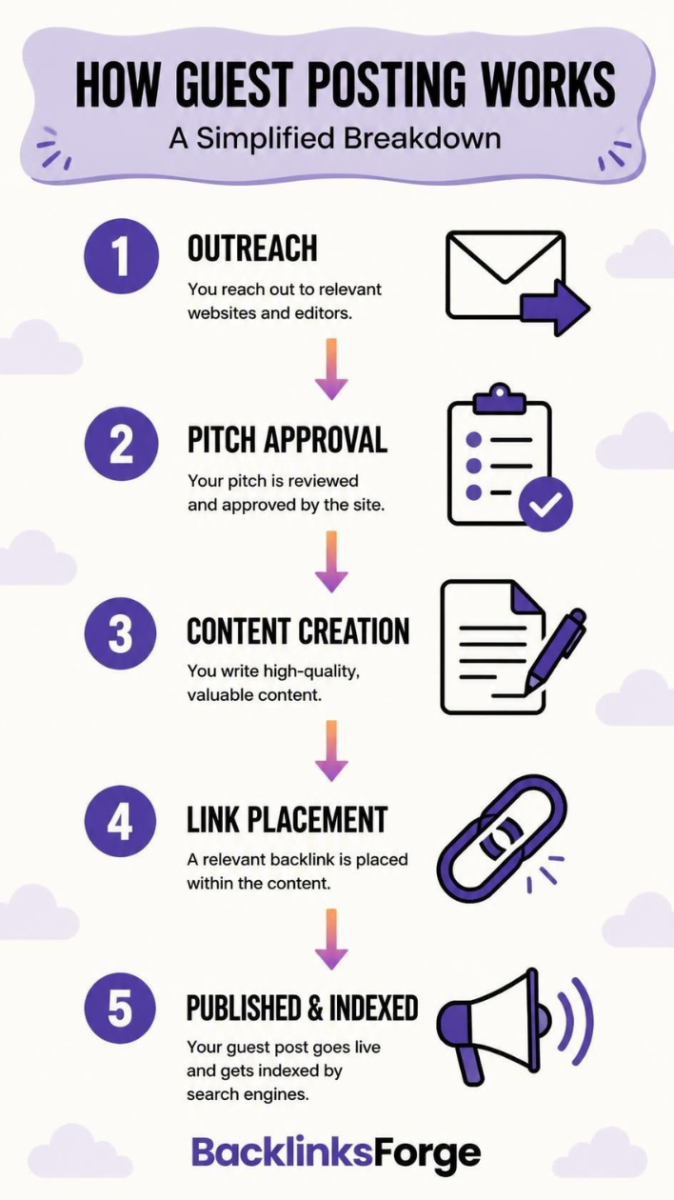
A legitimate guest posting campaign generally follows this workflow:
- Niche and target research — Identify websites that are genuinely relevant to your industry, have real organic traffic, an engaged readership, and healthy editorial standards.
- Outreach — Pitch a specific, useful topic idea to the site’s editor or contributor guidelines page, rather than sending a generic “can I write for you” email.
- Content creation — Write an original, well-researched article that would hold up on its own merits, with or without a link. Follow the host site’s tone, formatting, and contributor guidelines closely.
- Natural link placement — Include one or two contextual links to relevant pages on your site, using varied, natural anchor text rather than exact-match commercial keywords.
- Editorial review — The host site edits, fact-checks, and approves the piece the same way it would any staff-written content.
- Publication and promotion — Once live, share the piece across your own channels to maximize its reach and referral traffic.
- Tracking — Monitor the resulting backlink, referral traffic, and any ranking movement on the linked pages using tools like Google Search Console, Ahrefs, or Semrush.
Best Practices for Guest Posting That Actually Works in 2026
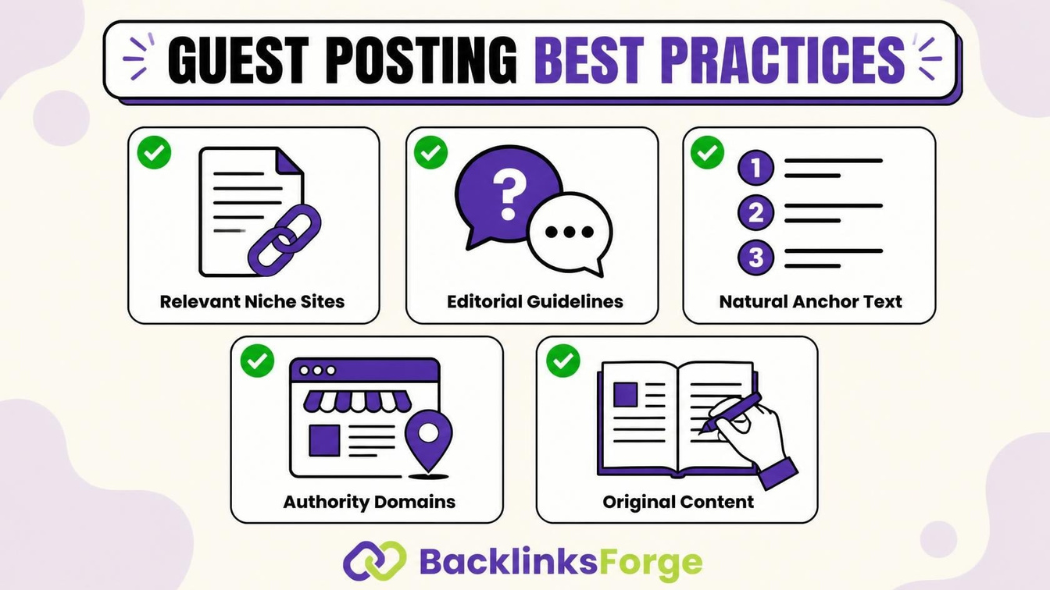
- Prioritize relevance over domain metrics. A moderately-trafficked site that’s a perfect topical match beats a huge, unrelated domain every time.
- Write for the reader first. If an editor wouldn’t accept the article without the link, it isn’t good enough yet.
- Diversify anchor text. Overusing exact-match keyword anchors is one of the clearest spam signals in a backlink profile.
- Avoid paid link networks and PBNs. Sites that openly sell guest-post placements for links are exactly what Google’s spam systems are built to catch.
- Check editorial standards before pitching. Look for real authors, active comments, social shares, and consistent publishing history — signs of a genuine editorial site rather than a link farm.
- Limit guest posts per site. One well-placed, high-quality article on a reputable site is worth more than a dozen posts spread across marginal domains.
- Disclose sponsored content appropriately. If a placement is paid, use rel=”sponsored” per Google’s guidelines rather than disguising it as organic editorial content.
- Match content depth to the topic. Thin, generic 500-word posts rarely get accepted by quality publications and rarely earn meaningful SEO value even when they do.
Guest Posting vs. Other Link-Building Tactics
| Tactic | How It Works | Best For |
|---|---|---|
| Guest posting | Contribute an article to an external site in exchange for a link and exposure | Authority building, referral traffic, thought leadership |
| Digital PR | Pitch data, research, or newsworthy stories to journalists and publications | Large-scale link acquisition, brand awareness |
| HARO / journalist requests | Provide expert quotes for reporters writing articles | Fast, low-effort authority links |
| Niche edits | Get a link added to an already-published, relevant article | Efficient link placement without new content |
| Broken link building | Find dead links on relevant pages and suggest your content as a replacement | Low-cost, scalable outreach |
Most mature SEO strategies blend several of these tactics rather than relying on guest posting alone.
Common Guest Posting Mistakes to Avoid
- Pitching irrelevant sites just because they have high domain authority
- Stuffing articles with keyword-optimized anchor text instead of natural language
- Buying links from guest-post marketplaces that mass-publish low-effort content
- Ignoring a site’s contributor guidelines and submitting generic, unedited drafts
- Treating guest posting as a one-off tactic rather than a relationship-building process
- Publishing AI-generated content with no fact-checking, original insight, or genuine expertise behind it
Frequently Asked Questions
Is guest posting still safe for SEO? Yes, when the content is genuinely useful, published on a real editorial site, and not part of a paid link scheme designed purely to manipulate rankings.
Does Google penalize guest posting? Google penalizes manipulative link schemes — including guest-post networks built solely to sell links — not the practice of contributing legitimate, editorial content to relevant publications.
How many guest posts do I need for SEO results? There’s no fixed number. A handful of high-quality placements on genuinely authoritative, relevant sites typically outperforms dozens of low-quality posts on unrelated domains.
What’s the difference between guest posting and guest blogging? The terms are used interchangeably in most of the industry — both refer to writing content for publication on someone else’s website.
Should guest post links be dofollow or nofollow? Editorial links earned on merit are commonly dofollow, but many publications now use nofollow or sponsored attributes for contributor bios, in line with Google’s link attribute guidelines. Either way, the traffic, exposure, and brand-authority value remain.
The Bottom Line
Guest posting in SEO is the practice of publishing content on relevant third-party websites to earn backlinks, referral traffic, and brand authority — and more than a decade after Google supposedly declared it dead, it remains one of the most widely used link-building strategies in the industry, precisely because editorial-quality guest contributions still deliver real value to readers and real trust signals to search engines.
The tactic that fails is transactional, keyword-stuffed, mass-produced guest posting aimed purely at manipulating rankings. The tactic that works — consistently, safely, and sustainably — is genuine, well-researched contribution to sites your audience already trusts.
For businesses that want this done at scale without the outreach grind, agencies like BacklinksForge specialize in vetted, niche-relevant guest post placements that follow this exact editorial-first approach.