

If you’ve spent any time researching SEO, you’ve almost certainly come across the term Domain Authority (DA). It’s one of the most widely referenced metrics in the industry, thrown around in agency pitches, backlink marketplaces, and SEO tool dashboards alike. Yet despite how often it’s mentioned, it’s also one of the most misunderstood concepts in search engine optimization.
In this guide, we’ll break down what Domain Authority actually is, where it came from, how it’s calculated, what factors influence it, how it compares to similar metrics like Domain Rating and Authority Score, and — most importantly — how you can improve it for your own website with a realistic, long-term strategy.
What is Domain Authority?
Domain Authority (DA) is a search engine ranking score developed by Moz, one of the earliest and most respected SEO software companies. It’s measured on a scale of 1 to 100, and the higher the score, the greater a website’s likelihood of ranking well on search engine results pages (SERPs) relative to other websites.
In simple terms, DA is a predictive, comparative metric — it doesn’t directly influence Google’s ranking algorithm, but it gives you a solid, logarithmic estimate of how competitive your site is compared to others, particularly within the same niche or industry.
A few important things to understand about DA from the outset:
- It is not an official Google ranking factor — it’s a third-party metric created by Moz, based on Moz’s own crawl data (the Link Explorer index), not Google’s index.
- It’s mainly used for comparative purposes — to see how one website’s authority stacks up against a competitor’s, or to track your own site’s progress over time.
- The scale is logarithmic, not linear — moving from DA 20 to DA 30 is considerably easier than moving from DA 70 to DA 80. The higher you climb, the harder each additional point becomes to earn.
- New domains typically start with a very low DA (often 1–10), while established, trusted sites like Wikipedia, major news outlets, or government domains can score 90+.
A Brief History: Where Did Domain Authority Come From?
Domain Authority was introduced by Moz as an alternative to Google’s now-deprecated PageRank metric, which Google stopped publicly updating around 2016. SEOs needed some way to gauge a site’s overall link-based strength, and Moz filled that gap with DA (alongside Page Authority for individual pages).
Since then, Moz has revised its DA algorithm multiple times — most notably in 2019, when the scoring model was substantially overhauled to make scores more predictive of actual ranking performance. This is why some websites saw their DA scores shift significantly overnight even though nothing about their backlink profile had changed — the scale itself had been recalibrated.
Understanding this history matters because it explains why DA numbers aren’t fixed truths — they’re index-dependent estimates that get updated as Moz’s crawler and algorithm evolve.
How is Domain Authority Calculated?
Moz uses a machine-learning model that combines dozens of link-related signals into a single score. Here are the main factors that go into it:
1. Linking Root Domains (Referring Domains)
The number of unique websites linking to you matters more than raw link count. Ten backlinks from ten different domains carry more weight than 100 backlinks from a single domain. This is one of the strongest correlating factors with DA.
2. Total Number of Backlinks
Backlink volume plays a role, but quantity without quality has limited impact on your overall authority. A site with 50,000 backlinks from a handful of low-quality domains will often underperform a site with 500 backlinks from diverse, reputable sources.
3. Link Quality and Trust Signals
Backlinks from high-authority, trusted sources — think educational (.edu), government (.gov), or well-known news and industry domains — carry significantly more weight than links from low-quality or spammy directories. This ties closely into what’s sometimes called “link equity” or “link juice” passed from one site to another.
4. MozRank and MozTrust
These are internal Moz metrics that measure link popularity and link trustworthiness respectively. MozRank looks at how many links point to a page (and how strong those linking pages are), while MozTrust measures how closely linked a site is to a set of seed, highly trusted domains. Together, they feed into the overall DA calculation.
5. Spam Score
Websites with unnatural link patterns, thin or duplicate content, excessive exact-match anchor text, or listings on low-quality directories tend to have a higher Spam Score, which drags down Domain Authority. A high Spam Score can also make a site more vulnerable to manual penalties.
6. Domain Age and Historical Link Velocity
While not an official standalone factor, domains that have consistently earned links over a longer period (rather than in sudden, unnatural bursts) tend to build authority more sustainably.
Domain Authority vs Page Authority vs Domain Rating vs Authority Score
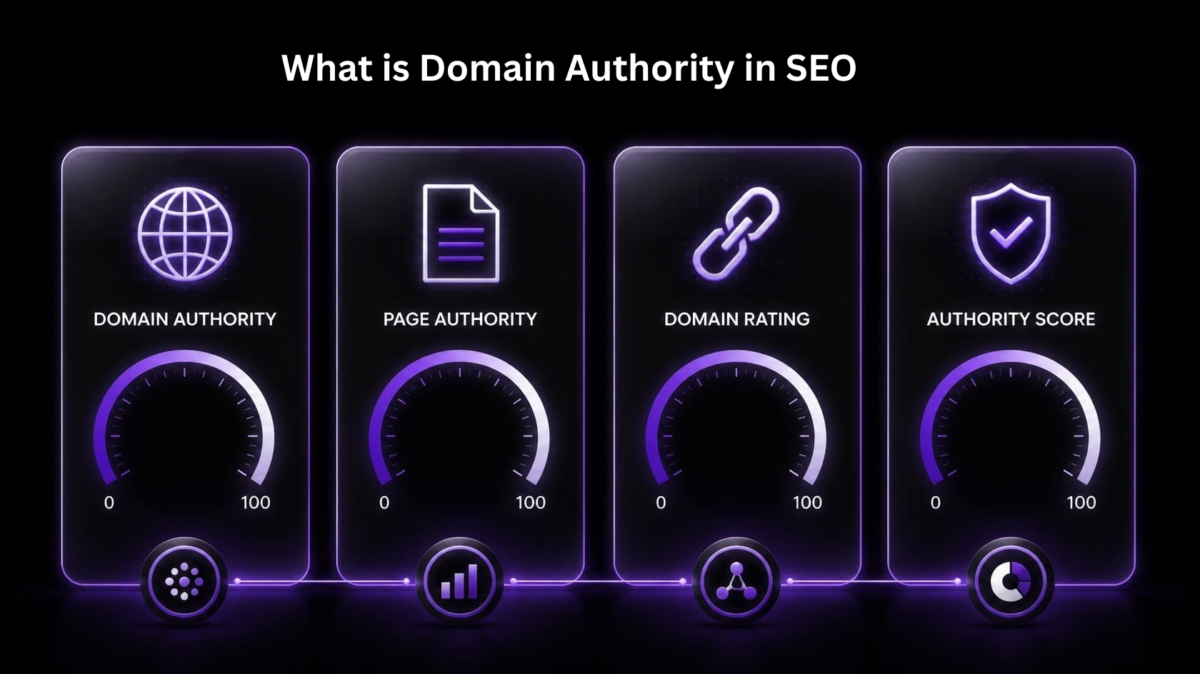
These terms often get mixed up, so here’s a clear breakdown:
| Metric | Tool | What It Measures |
|---|---|---|
| Domain Authority (DA) | Moz | Overall ranking strength of an entire website/domain |
| Page Authority (PA) | Moz | Ranking strength of a single, specific page |
| Domain Rating (DR) | Ahrefs | Strength of a domain’s backlink profile, based on Ahrefs’ own crawl index |
| Authority Score (AS) | Semrush | Semrush’s equivalent metric, combining backlink data with organic traffic and spam signals |
All these metrics share the same underlying goal — expressing off-page SEO strength and trustworthiness as a single number — but each tool crawls the web independently and uses its own algorithm and dataset. That’s why the exact same website can show a DA of 45, a DR of 62, and an AS of 38 all at once. None of these numbers is “more correct” than another; they’re simply different lenses on the same underlying concept.
Rule of thumb: Never cross-compare these numbers between tools. Only compare within the same tool — for example, using Moz’s DA to compare your site against three competitors, all measured with the same Moz index.
How Does Domain Authority Impact SEO?
While DA isn’t a direct Google ranking factor, it has real, practical implications for SEO performance and is a useful proxy for a site’s overall off-page strength:
- Better Rankings — High-DA websites tend to rank more easily for competitive keywords, thanks to their stronger backlink profiles and trust signals accumulated over time.
- Faster Crawling & Indexing — Search engines tend to crawl and index pages from high-authority domains more frequently and thoroughly, meaning new content gets discovered and ranked faster.
- Easier Link Building — Once your site has established authority, other websites (and journalists, bloggers, and partners) are more willing to link to you, creating a positive compounding effect often called the “authority snowball.”
- Resilience to Algorithm Updates — Sites with strong domain authority typically recover faster from the impact of core algorithm updates, since their overall trust and relevance signals are more deeply established.
- Brand Trust and Credibility — A high DA isn’t just a search engine signal; it also reflects real-world credibility to human visitors, potential link partners, and even investors or business partners evaluating your online presence.
- Better Negotiating Power for Partnerships — Sites with higher DA are more attractive for sponsorships, affiliate partnerships, and co-marketing opportunities.
How to Check Domain Authority
Here are the most common tools used to check DA and comparable metrics:
- MozBar — A free browser extension that displays DA and PA directly on the SERP as you browse, useful for quick competitor checks.
- Moz Link Explorer — Gives a detailed backlink profile along with DA/PA breakdowns, top linking domains, and anchor text distribution.
- Semrush Authority Score — Found in the Domain Overview tool; combines backlinks, organic traffic, and spam signals into a single score.
- Ahrefs Domain Rating (DR) — An alternative metric focused specifically on backlink profile strength, paired with the Ahrefs Rank for overall site comparison.
It’s just as important to track your competitors’ DA as your own — this gives you a clear picture of where you stand within your niche and helps set realistic link-building targets. Many SEOs track DA monthly alongside organic traffic and keyword rankings to spot correlations over time.
How to Improve Domain Authority
If you want to grow your website’s Domain Authority, here are proven, actionable strategies — none of them are shortcuts, but all of them compound over time:
1. Build High-Quality Backlinks
Focus on quality over quantity. Guest posting on relevant, reputable sites, digital PR campaigns that earn coverage from journalists, and organic mentions from industry publications are the most effective long-term approaches. A single link from a respected, topically relevant domain can outweigh dozens of low-quality directory links.
2. Strengthen Your Internal Linking Structure
Strategically link between pages on your own site so link equity flows properly throughout your domain. Cornerstone content and pillar pages should receive the most internal links from supporting articles.
3. Disavow Toxic or Spammy Backlinks
If your site has picked up low-quality or spammy backlinks over time — often from negative SEO attacks or old, low-quality directory submissions — use Google’s Disavow Tool to remove their negative influence on your overall trust signals.
4. Publish High-Quality, Original Content
Content that provides genuine value naturally attracts links — these are often called “linkable assets”: original research, data studies, in-depth guides, free tools, or calculators. This is generally far more sustainable than manually chasing individual backlinks.
5. Optimize On-Page and Technical SEO
Meta tags, header structure, keyword placement, site speed, mobile-friendliness, and clean URL structures are on-page and technical factors, but they indirectly support authority-building by improving user engagement, dwell time, and crawlability — all of which make your content more “linkable” in the first place.
6. Fix Broken Links and Crawl Errors
Crawl errors, broken backlinks (both inbound and outbound), and slow-loading pages all get in the way of authority growth. Regular technical audits using tools like Google Search Console help catch these issues early.
7. Diversify Your Anchor Text
Over-optimized, exact-match anchor text can look manipulative to both search engines and authority-scoring algorithms. A natural mix of branded, generic, and partial-match anchors builds a healthier, more trustworthy backlink profile.
8. Stay Consistent
Domain Authority doesn’t grow overnight. It’s a long-term process that rewards consistent link building, content publishing, and technical maintenance over months — not days or weeks.
Domain Authority Benchmarks: What’s a “Good” Score?
Since DA is relative, there’s no single universal number that counts as “good” — it depends entirely on your niche and competitors. That said, general benchmarks many SEOs use as rough reference points:
- DA 1–20 — New or very small websites, typically with minimal backlink profiles.
- DA 20–40 — Growing websites with a developing link profile; common for small businesses and niche blogs.
- DA 40–60 — Established, competitive websites with solid authority in their industry.
- DA 60–80 — Strong, well-known industry players and larger publications.
- DA 80–100 — Major global brands, top-tier news outlets, and massive reference sites like Wikipedia.
The more useful exercise is always comparing your DA directly against the specific competitors ranking for your target keywords, rather than chasing an arbitrary global number.
Common Misconceptions About Domain Authority
- “DA is a Google ranking factor” — False. It’s a third-party estimate built on Moz’s own index, not something Google itself calculates or uses.
- “A higher DA guarantees better rankings” — False. Relevance, search intent, content quality, and on-page SEO matter just as much, if not more, for any individual keyword.
- “Only the number of backlinks matters” — False. Link quality, topical relevance, and diversity of referring domains matter more than raw volume.
- “DA can be improved overnight” — False. It’s a gradual process that plays out over months of consistent effort, not a quick fix from buying a batch of links.
- “A low DA means my site can never rank” — False. Lower-competition, long-tail keywords can absolutely rank even from lower-DA sites with strong on-page relevance.
Conclusion
Domain Authority is a genuinely useful benchmarking tool for understanding your website’s off-page SEO strength — especially relative to competitors in your niche. But treating it as the sole ranking factor, or obsessing over the exact number, is a mistake that distracts from the fundamentals. The best SEO strategy combines high-quality, relevant backlinks, strong original content, and solid technical SEO — and when you get that combination right, Domain Authority improves naturally, along with the organic rankings and traffic that actually move the needle for your business.
If you’re looking for high-quality guest posts and white-hat backlinks that genuinely move the needle on Domain Authority and organic rankings, that’s exactly the kind of long-term, relationship-based link-building work worth investing in.
Keywords covered: domain authority, page authority, off-page SEO, backlink profile, referring domains, link building, spam score, domain rating, authority score, MozBar, SERP ranking, anchor text, organic traffic, trust flow, link equity, linkable assets, technical SEO.